“The greatest barrier to learning isn’t a lack of intelligence; it is the fear of being wrong.”
– Michael O’Shaughnessy
The Silent Classroom: When the Fear of Being Wrong Becomes the Greatest Barrier
Imagine this scene, one you’ve likely witnessed countless times if you’ve spent any time in a classroom. You pose a question, perhaps about the nuances of a historical event or the mechanics of a complex equation. Silence descends. Three students might have a solid grasp of the answer, one is reasonably sure, but not a single hand rises. The air hangs heavy with unspoken thoughts. Are they struggling because they don’t know, or because they’re afraid to be wrong? This common scenario can quickly lead to a spiral: fear of being wrong leads to silence, which means less participation, fewer opportunities to think aloud, reduced feedback, and ultimately, slower learning.
Finally, you call on someone. “I don’t know,” they mumble, looking down at their desk. But the truly interesting question isn’t necessarily, “Why don’t they know?” It’s a more profound inquiry: “What if they do know—but they’re afraid to be wrong?”
This gets us to the heart of the matter. We often interpret a student’s reluctance to answer as a straightforward lack of knowledge. Yet, sometimes, the student isn’t afraid of not knowing the answer; they’re afraid of what happens if they reveal that they don’t know—or worse, reveal an answer that is incorrect. What if we’ve inadvertently created classrooms where being right is the ultimate goal, rather than genuine learning?
What Are We Really Seeing? Unpacking the Silence
The quiet in our classrooms, that collective holding of breath, is often misdiagnosed. We see silence and default to “they don’t know.” But, as we’ve discussed, it can just as easily be evidence of risk avoidance. If a student believes that being wrong is synonymous with “not being smart,” then we’ve created a direct conflict between intelligence and the very act of learning. And here’s the uncomfortable truth: learning, almost by its very nature, demands that we be wrong sometimes.
Consider the journey of understanding. A student grappling with fractions might initially develop a misconception. They test an idea, it doesn’t work, they discover why, and then they modify their thinking. That, right there, is the essence of learning. Science provides a particularly powerful example of this process: Hypothesis → prediction → experiment → unexpected result → revise the model. Scientists don’t view an incorrect hypothesis as a personal failure; they see it as invaluable information. Why should our students be any different?
This brings us to a crucial distinction between “being wrong” and “failing.” Being wrong is an intellectual condition—a moment in the journey of understanding. Failure, however, is what we decide that condition means. This is a powerful concept for educators, one that helps us in Resolving Everyday instructional challenges by reframing how we perceive errors.
The Uncomfortable Truth: Being Wrong is Part of Learning
The phrase “greatest barrier” is intentionally provocative. It makes us pause and ask, Really? Greater than lack of resources? Greater than learning disabilities? Greater than poor instruction? Of course, students face myriad barriers to learning—poverty, learning differences, inadequate instruction, language barriers, lack of resources, and countless others. My point isn’t that those barriers don’t matter. It’s that even an intelligent, capable student, paralyzed by the fear of being wrong, can become an unwilling participant in their own learning journey.
Research strongly supports this underlying classroom phenomenon: students’ fear of giving an incorrect answer can drastically reduce participation, while educators can deliberately cultivate environments where mistakes become rich opportunities for learning. Janet Metcalfe’s 2017 review on “learning from errors” highlights that while error avoidance is common in American classrooms, experimental research suggests it can be counterproductive. When errors are followed by appropriate corrective feedback, making mistakes can actually improve learning.
Productive Failure: A Paradigm Shift
- Wrong answer + correction = potentially powerful learning experience.
- Fear of wrong answer + silence = no opportunity to learn from the error.
There’s a substantial research tradition around “productive failure,” championed by Manu Kapur and others. The fascinating idea is to let students genuinely struggle with a problem before providing formal instruction. Students will often produce incorrect or incomplete solutions, but these attempts provide a vital baseline for comparison against the eventual correct solution. A study on learning from errors found that students prompted to compare their erroneous solutions with correct ones subsequently performed better than those simply shown correct solutions. Elaborating on errors, it seems, is an important part of the learning process.
Consider the student who says, “I think the answer is 24,” only to discover it’s 36. That moment has just created a profound learning opportunity. But this only happens if the classroom response is, “Interesting. Let’s figure out where your thinking took you,” rather than a dismissive, “No. The answer is 36.” These are two profoundly different learning experiences, and the latter simply shuts down the very process we aim to foster.
Cultivating a Culture of Intellectual Risk-Taking
It’s crucial to understand that simply allowing students to make mistakes isn’t a magic bullet. The research is clear: what happens after the mistake matters immensely. A mistake followed by thoughtful feedback, comparison, explanation, and revision can produce robust learning. Conversely, a mistake followed by embarrassment, a quick correction, or an immediate move to a student who “knows it” may not only fail to foster learning but also reinforce the fear we’re trying to dismantle.
Research on classroom error-management climate indicates that teachers’ responses to student mistakes profoundly influence students’ attitudes and emotions surrounding those mistakes. If every incorrect answer generates a sense of shame, public correction, or even laughter from classmates, students receive a very logical, albeit damaging, message: Don’t risk being wrong. And students, being the astute learners they are, become excellent at internalizing that lesson.
Treating Wrong Answers as Data
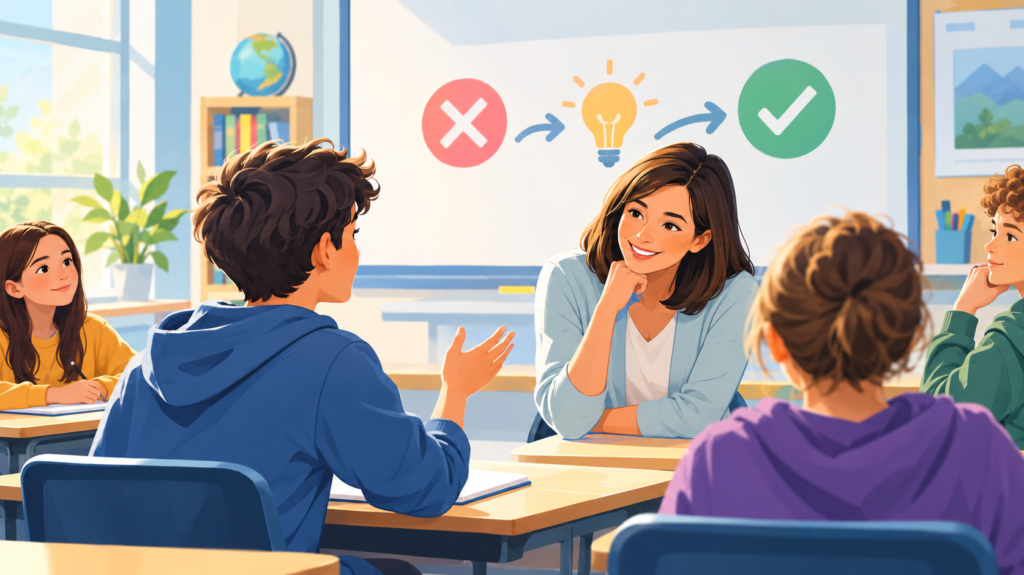
This is where your practice as an educator can become truly transformative. Instead of focusing on the final “right” answer, we shift to understanding the thinking behind the answer. An incorrect answer isn’t the end of the learning process; it’s data. Just as a scientist doesn’t say, “Our hypothesis was wrong. Shut down the experiment,” but rather, “Interesting. What does that result tell us?” we can adopt a similar stance in the classroom. When a student says, “I got the wrong answer,” our response can be, “Good. Now we have something to investigate.” That’s a completely different classroom culture, one that fosters true intellectual curiosity.
Here are some practical shifts in our questioning strategies:
- Instead of: “Who knows the answer?” Try: “What are you thinking?”
- Instead of: “No, that’s incorrect.” Try: “Interesting. Tell me how you got there.”
- Instead of: “Who has the right answer?” Try: “What are some different answers we’re getting?”
- And perhaps my favorite: “Who changed their answer? What changed your thinking?” This last question is particularly powerful because it makes changing your mind visible not as a failure, but as a clear, tangible act of learning.
The Unofficial Curriculum: What Are We Teaching About Being Wrong?
Every classroom, whether we explicitly recognize it or not, teaches two curricula. There is the official curriculum—fractions, algebra, literature, science, history, writing. And then there is the unofficial curriculum, often far more impactful: What happens when I’m wrong? What happens when I don’t know? Is it safe to ask a question? Can I change my mind? Does my teacher value my thinking, even when my thinking is incorrect?
Reread the quote: “The greatest barrier to learning isn’t a lack of intelligence; it is the fear of being wrong.” Perhaps one of the most important things we can teach our students isn’t how to always be right. It’s how to be wrong without being afraid to learn from it. It’s about empowering them to embrace the messy, iterative, and often incorrect path that leads to true understanding. Now it’s your turn to make a difference: go out there and light up a mind!