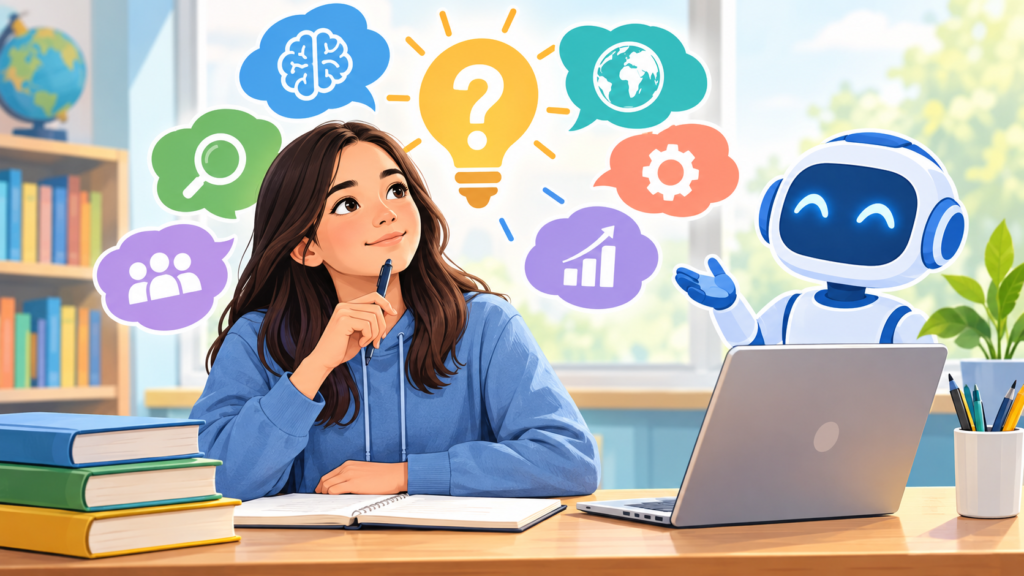
“The right question is usually more important than the right answer.”
– Plato
Why the Right Question Matters More Than the Right Answer
Consider this famous quote from Plato: “The right question is usually more important than the right answer.” In our current educational landscape, this timeless philosophical idea has transformed from a reflective classroom discussion into an urgent operational necessity. Think about it: today, a student can open an AI tool, plug in a prompt, and get a polished, grammatically correct answer to almost any factual question in three seconds flat. Google, Claude, Gemini, and a hundred other tools have effectively commoditized the “right answer.”
So, where does that leave our classrooms? If giving students a prompt and grading the final written output is our primary mode of assessment, we are essentially running an auditing service for algorithms rather than teaching human beings how to think. But as I explore in my upcoming book, this isn’t a crisis to panic over—it’s an invitation to evolve. It means our classrooms need to shift away from assessing static, AI-vulnerable end products and move toward cultivating deep human inquiry. It starts with asking better questions.
The Problem with “Answer-Driven” Classrooms
For decades, traditional assessment operated on a simple, transactional contract: the teacher assigns a standard prompt, the student writes a product, and the teacher grades the deliverable. Generative AI has permanently broken that contract. When an algorithm can generate a research report or solve a multi-step problem instantly, traditional end-product evaluations leave educators caught on an exhausting “policing treadmill” of detection software and compliance auditing.
More dangerous than the loss of academic integrity is the accumulation of cognitive debt. When students prematurely outsource their mental friction to artificial intelligence, they bypass the messy cognitive struggle required to build durable schema in long-term memory. If we want students to retain knowledge and develop genuine critical thinking, we have to stop handing them questions that have a single, Googleable answer.
Enter Essential Questions: The Antidote to Quick Answers
To break this cycle, educators need tools that force students to wrestle with complexity. This is where Essential Questions (EQs) come in. Grounded deeply in the work of educational experts Jay McTighe and Grant Wiggins in their seminal book, Essential Questions: Opening Doors to Student Understanding, true EQs are specifically designed to resist easy answers. Unlike standard recall questions, a true Essential Question possesses distinct characteristics:
- Open-ended: It does not have a single, neat “correct” answer.
- Thought-provoking: It sparks active intellectual engagement, debate, and discourse among students.
- Drives higher-order thinking: It requires students to analyze, evaluate, justify, and synthesize information.
- Transferable: It points toward big ideas that stretch across multiple units, subjects, and real-world contexts.
- Recursive: It can—and should—be revisited over time as students grow in maturity and knowledge.
Yes, AI Can Answer an Essential Question—And That’s Okay
Now, here is the reality check that every teacher eventually runs into: if you give an Essential Question to an AI tool, it will generate a sophisticated answer. In fact, you can test it on Claude or Gemini right now, and it will churn out a well-reasoned response.
Does that mean EQs are useless in the age of AI? Absolutely not. In fact, it reveals the exact brilliance of the approach. An AI-generated answer is a starting point, not the destination.
Even if a student uses AI to help brainstorm or draft a response to an overarching inquiry, they still have to read it, process it, decide whether they actually agree with the logic, and internalize the underlying concepts. More importantly, when that student is asked to step up—whether in a classroom Socratic seminar, a small-group debate, or a live oral defense—the artificial intelligence isn’t there to whisper in their ear. If they didn’t do the mental heavy lifting to internalize the material, they won’t be able to defend their position.
The learning doesn’t happen in the static written artifact anymore; the learning happens in the internalizing, the discussion, and the defense.
Bringing It All Together
Plato understood millennia ago that the query dictates the quality of the discovery. By shifting our classroom focus from collecting right answers to wrestling with essential questions—and backing those up with authentic discussions, portfolios, and oral justifications—we transform AI from a cheating tool into an intellectual sparring partner for Resolving Everyday challenges, academic or otherwise.
To help you get started right away, I’ve put together a ready-to-use prompt generator designed specifically to help teachers craft powerful Essential Questions for any unit or grade level. Grab the free download below, plug it into your favorite AI tool, and start engineering deeper thinking in your classroom tomorrow!
Now it’s your turn to make a difference: go out there and light up a mind!