“We cannot simply react to AI by trying to keep things as they were; we must actively determine what needs to change.”
— Peter DeWitt
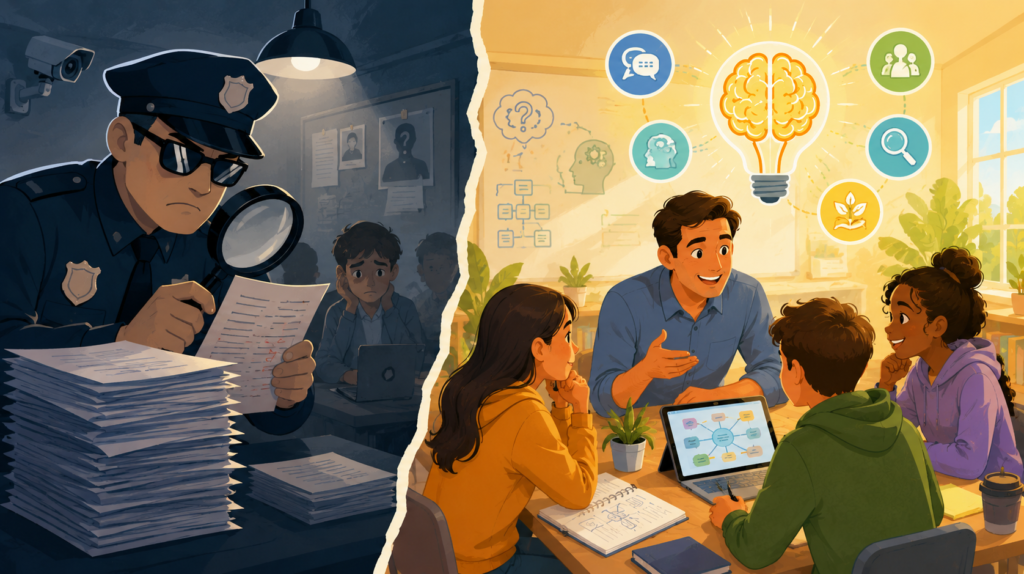
Police or Coach?
As school districts across the nation are heading back to school, educators face a critical question: Will we continue to be Classroom Police, or will we become Cognitive Coaches?
Every educator today knows the hollow feeling of reading a flawless essay and suspecting—but not proving—that the student didn’t write it. We’ve all spent hours scanning text, searching for tell-tale phrases, playing detective, and frankly, it’s exhausting. Starting another academic year trapped in that cycle of suspicion is a recipe for burn-out.
We are caught in a legacy contract. For the last century, the agreement was simple: a student produced a static product (an essay, a worksheet, a standard research project), and that static product was considered proof of learning. Today, because AI can generate that exact product in three seconds, that entire contract is void.
If we continue to demand compliance with that old contract, we force ourselves into the unwinnable role of compliance auditors—the classroom police.
To escape this trap, we need more than new rules; we need a complete mindset pivot. Instead of hyper-focusing on the final output, we must fall in love with the process of thought itself. The true value of human education isn’t the final five-paragraph essay; it’s the cognitive work the student did to get there.
What Does It Mean to Be a Cognitive Coach?
Stepping out of the role of “Classroom Police” means stepping into the role of a Cognitive Coach.
A Classroom Police officer inspects the final product, looks for violations, and penalizes shortcuts. A Cognitive Coach, on the other hand, makes thinking visible. As a Cognitive Coach, you:
- Focus on Metacognition: You care less about what answer landed on the page and more about how the student arrived at that conclusion.
- Guide the AI Partnership: Rather than banning tools, you mentor students on how to critique, prompt, and question the information generated by technology.
- Prioritize Dialogue Over Deliverables: You engage in real-time conversations, asking students to defend their choices, explain their logic, and revise their ideas in real time.
Shifting your approach from trying to catch cheaters to actively guiding real-time human thought is the primary mechanism for resolving everyday teacher fatigue. When we prioritize active, verbal defense of student ideas over the mere collection of written papers, classroom engagement replaces compliance, and teaching becomes enjoyable again.
You can start this shift tomorrow by changing the types of questions you ask. Instead of asking students what they know, start asking them why they know it. When a student offers an answer, follow up with, “What evidence led you to that specific conclusion?” or “How did your thinking change from your first draft to this one?”
AI provides answers; as Cognitive Coaches, we must train students to provide the rationale.
Now it’s your turn to make a difference: go out there and light up a mind!