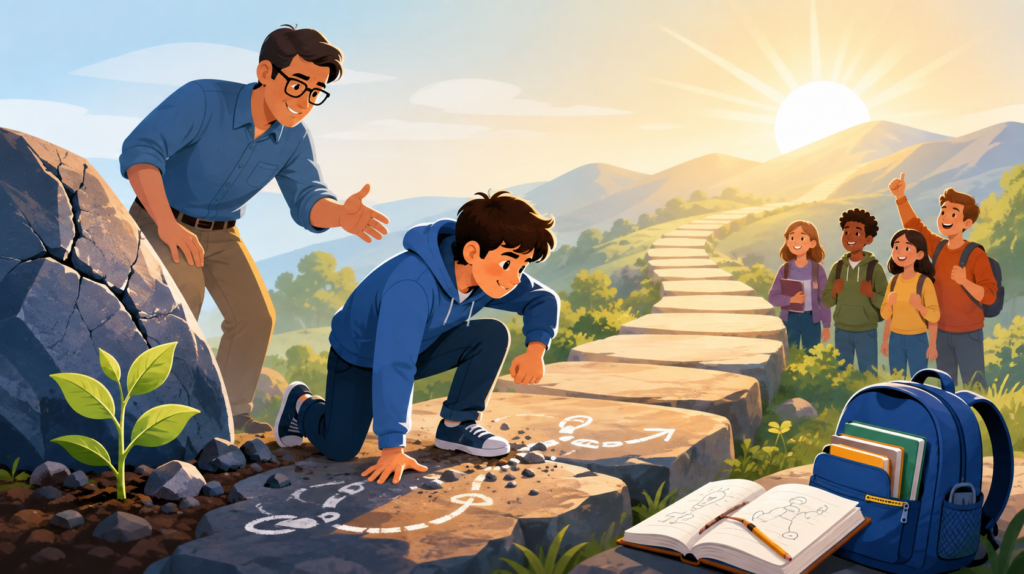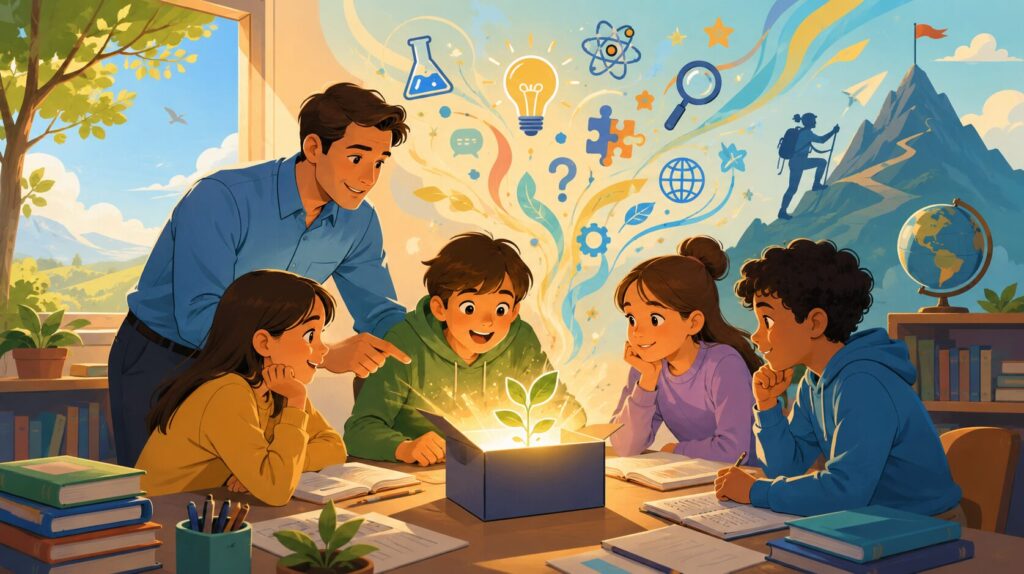
“We cannot teach people anything; we can only help them discover it within themselves.”
– Galileo Galilei
The Spark of Discovery: Igniting the Inner Learner
Galileo Galilei’s profound observation, “We cannot teach people anything; we can only help them discover it within themselves,” serves as a timeless beacon for us in education. It’s a powerful reminder that true knowledge isn’t a commodity to be transferred, but a journey of personal revelation. A teacher can explain, a mentor can guide, a textbook can inform, but the moment of genuine understanding—the ‘aha!’—that’s an internal alchemy, unique to each individual.
Think back to something as fundamental as tying your shoes. You likely heard instructions, watched demonstrations, perhaps even had someone guide your hands. But none of that truly ‘taught’ you until you, the individual, internalized those motions, wrestled with the laces, and finally, through your own effort and discovery, mastered the knot. The same holds true, even more so, for complex ideas.
Or consider your own journey into the classroom. Remember that first time standing before a sea of eager (or perhaps skeptical) faces? All the theories, all the lesson plans, all the sage advice from professors and mentors—did it truly teach you how to *teach*? Or did you truly learn when you were in the arena, navigating real-time questions, adapting on the fly, and discovering the rhythm of the classroom for yourself? The books and lectures were the stage; your actual experience was the performance where learning truly began. And as the years rolled on, your expertise grew, not just from more input, but from more personal discovery.
From Information Transfer to Inspiration: The Modern Classroom
In our current educational landscape, this Galilean wisdom is more pertinent than ever. Twenty years ago, education often revolved around the teacher as the primary dispenser of facts, with students diligently recording and regurgitating information for tests. But today, with information literally at our fingertips—thanks to the omnipresence of the internet and AI—the game has fundamentally changed. Memorizing facts and figures is no longer the pinnacle of learning; it’s simply the starting point.
So, how do we teach now? Our role has shifted dramatically from ‘sage on the stage’ to ‘guide at the side.’ We are no longer primarily tasked with filling minds, but with sparking curiosity and setting the conditions for self-realization. We must create environments that compel students to ask questions, to explore, to test hypotheses, and to uncover truths on their own. This isn’t just a pedagogical preference; it’s a necessity for preparing students for a future where adaptability and independent thought are paramount for Resolving Everyday challenges.
This approach manifests in many forms: STEM learning, problem-based learning, project-based learning, inquiry instruction. The label isn’t as important as the underlying philosophy: we must guide students to discover, to question deeply, and to defend their understanding. No computer, no AI, can replicate the nuanced, real-time feedback and the human connection that a skilled educator provides in fostering this kind of authentic discovery.
The Educator as Expert Learner: Our True Calling
Here’s the beautiful paradox in Galileo’s quote: if we cannot teach people anything, then what is our expertise? Our expertise lies not in knowing every single fact about a subject—a physics teacher doesn’t have to be a renowned physicist, nor a history teacher a professional historian. Our true mastery, our profound expertise, is in understanding *how* people learn. We are experts in pedagogy, in motivation, in fostering critical thinking, and in designing experiences that lead to personal discovery.
Great teachers do more than deliver information; they inspire curiosity. Great educational leaders do more than give instructions; they encourage independent thought and exploration. Our calling is to be architects of discovery, facilitators of insight, and cultivators of intrinsic motivation. We must be adept at:
- Crafting Compelling Questions: Questions that don’t have immediate, easy answers, compelling students to dig deeper.
- Designing Authentic Challenges: Problems that mimic real-world scenarios, requiring critical thinking and collaboration.
- Providing Timely Feedback: Guiding students not just to the right answer, but through the process of inquiry itself.
- Cultivating a Growth Mindset: Encouraging resilience and viewing mistakes as stepping stones to deeper understanding.
So, let us embrace this profound shift. Let us step fully into our role as guides, as inspirers, as experts in the art of learning itself. For in doing so, we don’t just educate; we empower. And that, truly, is our greatest contribution to the next generation.
Now it’s your turn to make a difference: go out there and light up a mind!