“We often say the only constant in education is change. But look past the shifting standards and new mandates, and you’ll find one truth that never budges: our ultimate job isn’t just to teach a subject, a grade level, or a test—it’s to prepare a human being for life.”
– Michael O’Shaughnessy
The Timeless Curriculum: Five Constants in a Changing Educational Landscape
If you spend enough time in education, you learn to expect the tides. Learning standards shift. They move up a grade, down a grade, get rebranded, get added, or get tossed out entirely. EdTech tools go viral and then vanish. It is easy to get caught up in the anxiety of the “new,” wondering if we are constantly preparing students for a moving target.
But if you step back from the curriculum maps, you realize something profound: the most important things we teach have not changed in twenty years, and they won’t change in the next twenty. While the academic standards are fluid, there is a “timeless curriculum” of human behavior. This is the bedrock upon which all other learning rests, the non-negotiable foundation for not just academic success, but life success.
The Five Pillars of Preparation: Constants in a Sea of Change
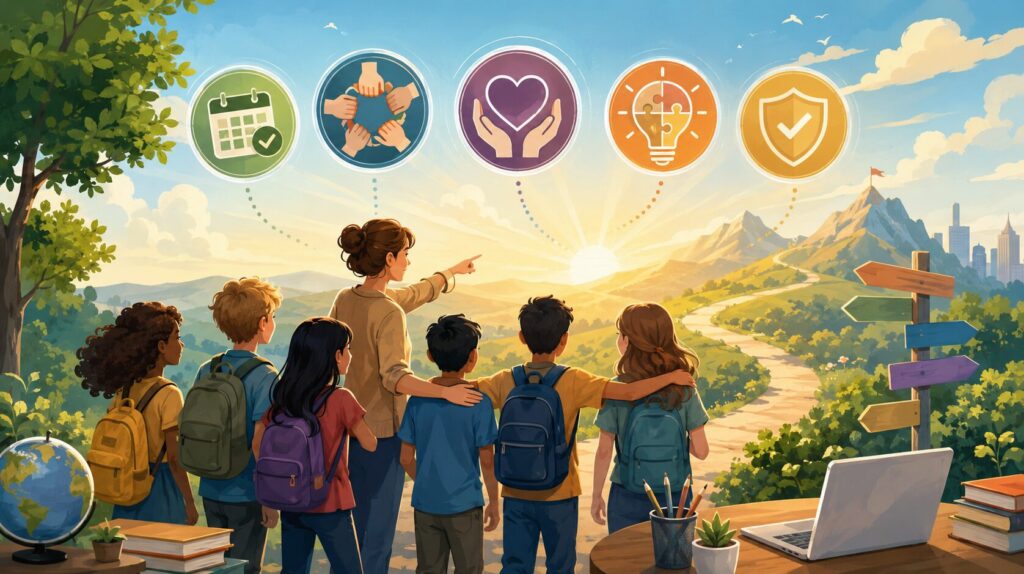
The core of our mission, as that opening quote reminds us, is to prepare human beings for life. This means cultivating essential attributes that transcend any particular subject or standardized test. Here are five constants that will always matter—both in the classroom and in the boardroom, forming the true curriculum for life:
Attendance: The Discipline of Showing Up
It sounds incredibly basic, but consistency is the foundation of all achievement. You cannot learn if you are not there. The discipline of showing up, consistently and reliably, is a fundamental life skill that begins with the first school bell.
- The Classroom Reality: A student with brilliant potential who only shows up 70% of the time will always struggle to build momentum, missing key connections and learning opportunities.
- The Career Parallel: What do employers need most? Reliability. Before talent, before strategy, before innovation—employers need people who simply show up when they say they will. It’s the first step in being a contributing member of any team or society.
Collaboration: Navigating the Group Project of Life
Students need to learn how to work in groups. This is often the most complained-about aspect of school (for both students and parents), but it is where the real magic happens. It is where students learn how to deal with people who disagree with them, how to negotiate, and how to hold themselves accountable to a team. These skills are critical for Resolving Everyday challenges that arise when diverse individuals must achieve a common goal.
- The Classroom Reality: The student who does all the work because “it’s easier than talking to people” misses the point of the exercise. They might get a good grade, but they’re opting out of crucial social and emotional development.
- The Career Parallel: Employers do not operate in vacuums. They want team players who can navigate diverse opinions, resolve conflict constructively, and carry their weight without a manager hovering over them.
Empathy, Humility, and Understanding: Walking a Mile in Their Shoes
Students need to learn how to see things from someone else’s perspective. The old adage still holds: you have to walk a mile in someone else’s shoes. They need to care about someone else’s feelings, and they need the humility to know they aren’t inherently better than anyone else in the room. This isn’t just about being “nice”; it’s about building a cohesive, functional society.
- The Classroom Reality: A classroom without empathy quickly devolves into a toxic, competitive environment where individual success is prioritized over community well-being.
- The Career Parallel: Do employers want the same? Absolutely. High emotional intelligence (EQ) is what separates a good manager from a toxic boss. Treating others fairly and with respect is a non-negotiable professional standard that builds trust and fosters productive environments.
Problem-Solving: The Courage to Try
Students need to know how to solve problems—or at least, they must not be afraid to try. The greatest barrier to learning isn’t a lack of intelligence; it is the fear of being wrong. We have to build environments where students are willing to look at a messy, unclear problem and take a swing at it, iterating and adapting as they go. This is the essence of Resolving Everyday obstacles, big or small.
- The Classroom Reality: The student who immediately raises their hand saying “I don’t get it” before reading the directions or attempting to grapple with the task is robbing themselves of cognitive growth and the joy of discovery.
- The Career Parallel: Leaders do not want employees who bring them every single roadblock. They want people who bring solutions, or at least a documented list of what they already tried before asking for help. The ability to autonomously tackle challenges is priceless.
Honesty and Trustworthiness: Owning the Mistake
Do not lie. Be accountable. If you did it, own it. In school, this looks like academic integrity and owning up to behavioral missteps. It’s about understanding that integrity is built one honest choice at a time.
- The Classroom Reality: A student who owns up to a missed assignment or a mistake immediately builds trust with their teacher. A student who makes excuses or plagiarizes destroys it, making genuine learning impossible.
- The Career Parallel: In the professional world, mistakes are expensive, but cover-ups are fatal. Trustworthiness is the currency of leadership. If you make a mistake, own it, fix it, and move forward. This builds a reputation of reliability and character.
Beyond the Standard: Cultivating Future-Ready Humans
The next time you feel overwhelmed by a new educational mandate or a shifting set of standards, take a deep breath. Remember that your ultimate job isn’t just to teach a specific set of grade-level standards. Your job is to use those standards as a laboratory to build human beings who show up, work well with others, practice empathy, tackle problems, and tell the truth.
If we get those five things right, our students will be ready for whatever the future throws at them, equipped with a robust internal compass that guides them through any change. This foundational work truly is about empowering future generations to thrive.
Now it’s your turn to make a difference: go out there and light up a mind!