“Don’t force children into your own ways, as they were created for a time different from your own.”
– Plato
Education for a Future Unknown: Beyond Our Own Ways
We’ve all been there, haven’t we? That familiar conversation with a well-meaning parent who, with a nostalgic glint in their eye, posits, “Well, it worked for me when I was in school.” And in our minds, we politely, patiently, but firmly retort, “Alright then, let’s remove all the computers, all the interactive whiteboards, all the technology, all the calculators.” The immediate recoil is almost palpable: “No, no, you can’t do that!” This little mental dance perfectly encapsulates the profound wisdom of Plato’s quote today. While it was originally directed at parents, its resonance within the modern educational landscape is undeniable.
Our students today inhabit a reality vastly different from even five or ten years ago, let alone the world many of us grew up in. We are tasked, as professional educators, with guiding them into a future that we ourselves cannot fully envision. I used to tell my students, with a knowing smile, that I was preparing them for jobs that didn’t even exist yet. Back when I was teaching, HTML coders commanded significant salaries; now, with a few clicks, you can launch a polished Google Site knowing zero HTML code. The very nature of information access has fundamentally changed. We’re beyond the era where rote memorization was a necessity simply because there was no other way to access information. Today, answers are literally at our fingertips, just a voice command away.
The Shifting Sands of Knowledge Acquisition
This seismic shift means we must move decisively away from the “drill and kill” worksheets and the recall of standardized facts. Our focus must pivot to conceptual understanding, critical thinking, and the profound ‘why’ behind the ‘what.’ It’s no longer enough to just get the correct answer; students need to grasp the underlying principles, the intricate connections that make that answer the correct one.
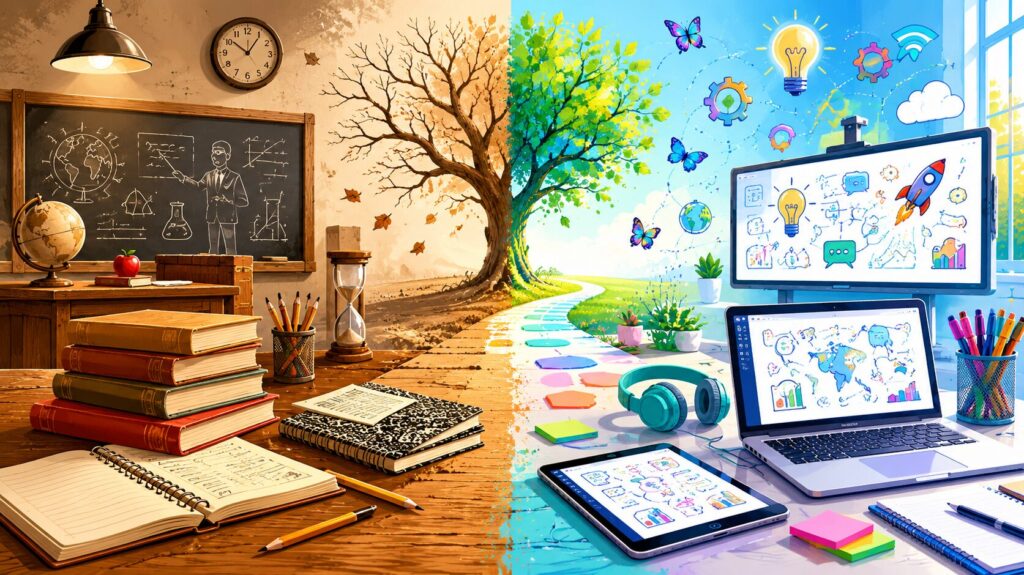
Sadly, we still encounter many classrooms operating under an antiquated information flow: teacher to textbook to student. This mindset is a relic. The teacher is no longer the “sage on the stage”; they must embrace the role of the “guide at the side.” This isn’t to say we need an individualized learning plan for every single student, nor that students should be solely in charge of their entire learning process. Rather, it means our approach to lesson design must evolve. We need more cross-curricular integration, more time to delve deeply into complex questions, and more opportunities for students to research, be creative, and discover alternative solutions—perhaps even solutions we hadn’t considered ourselves. This approach allows students to forge meaningful connections, making learning intrinsically interesting and pertinent to their lives, thereby Resolving Everyday challenges with ingenuity.
Navigating the Digital Tides
In our current climate, we frequently hear concerns about students being constantly on their devices, with screen time soaring. As educators, our responsibility isn’t to simply ban technology, but to find innovative ways to mitigate potential negatives while still leveraging its immense power. And what about the looming shadow of Artificial Intelligence? While AI won’t “take over everything” or replace teachers, it will undoubtedly replace teachers who don’t learn to use it. Our imperative is clear: we must prepare students to be productive members of a society where AI is an integral part of their professional and personal lives.
Bridging the Generational and Technological Gaps
We must acknowledge that there isn’t just a generational gap between today’s teachers and students; there’s also a significant technological gap. Educators must be willing to navigate these ever-changing waters, to continuously learn and adapt, ensuring they can effectively educate their students for a world that is, by its very definition, in a perpetual state of becoming. Plato’s insight reminds us that forcing children into our pedagogical “ways”—ways designed for a bygone era—is a disservice. Instead, we must nurture their innate capacity for learning through engagement and curiosity, much like his emphasis on “amusing their minds” rather than compelling them. Modern 1:1 devices, interactive displays, and AI-powered tools, when wielded thoughtfully, are precisely what allow us to identify and cultivate the “peculiar bent of the genius of each” student, preparing them for their unique time, not ours.
So, let us wholeheartedly embrace this challenge. Let us be the architects of educational experiences that empower students for an unpredictable future, not merely echoes of our past.
Now it’s your turn to make a difference: go out there and light up a mind!