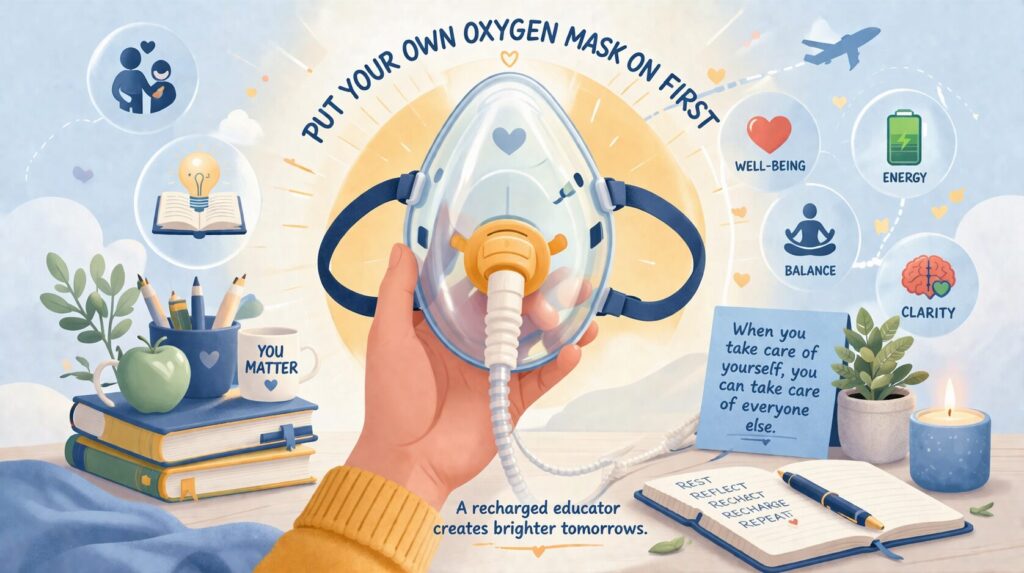
“Put your own oxygen mask on first.”
– Flight Attendants everywhere!
The Unseen Drain on Our Reserves
If you’ve spent more than a day in a K-12 classroom, a school office, or navigating the labyrinthine halls of educational administration, you know the feeling. It’s that unique blend of exhilaration and utter exhaustion, often within the same hour. We pour ourselves into lesson plans, student interventions, parent conferences, and data analysis. We celebrate the “lightbulb moments” and wrestle with the “complex problems” that walk through our doors every day. And, if we’re truly honest with ourselves, we often do it on fumes.
Teaching, at its core, is an act of relentless giving. We give our time, our energy, our emotional reserves, and often, a piece of our very soul. But here’s the rub: we can’t pour from an empty cup. This isn’t just a quaint saying; it’s a fundamental truth, one that flight attendants have been wisely imparting for decades.
Understanding the Oxygen Mask Analogy
Picture yourself on an airplane. The pre-flight safety briefing, as routine as it may seem, contains a profound piece of wisdom: in the event of an emergency, secure your own oxygen mask before assisting others. Why? Because if you pass out from lack of oxygen, you become a liability, not an asset. You can’t help anyone if you yourself are incapacitated.
This isn’t a call to selfishness; it’s a blueprint for sustainable service. In education, our “passengers” are our students, our colleagues, our school communities. They depend on us to be present, engaged, and effective. If we are running on empty—stressed, burnt out, and emotionally depleted—our ability to effectively teach, mentor, and lead diminishes dramatically. Our “tinted lens” of exhaustion can warp our perspective, making every challenge feel insurmountable and every interaction a drain.
The Algorithmic Nature of Self-Care
Think of your personal well-being as a complex system, much like an algorithm. Just as a well-written script needs proper inputs and regular maintenance to function efficiently, so do we. Ignoring the warning signs—the persistent fatigue, the short temper, the loss of passion—is like ignoring a missing semicolon in your code. Eventually, the whole program crashes.
To truly excel in this high-stakes environment, we must adopt a proactive, rather than reactive, approach to self-care. It’s about more than just taking a mental health day when you’re already at breaking point; it’s about building resilience into your daily routine. It’s about consciously choosing to nourish the “good wolf” within you, ensuring it has the energy to tackle the “internal battles” and the external demands.
This isn’t just about personal comfort; it’s about professional efficacy. A well-rested, mentally clear educator is better equipped for “deconstructing complex problems,” fostering civil discourse in the classroom, and creating those genuine “lightbulb moments” for students. It’s about Resolving Everyday challenges with clarity and sustained energy, rather than just surviving them.
Practical Steps to Recharge Your Battery
So, how do we consciously put on our oxygen masks in the chaotic world of K-12 education? It requires intentionality and a commitment to ourselves that’s just as strong as our commitment to our students.
- Set Boundaries: This is perhaps the hardest, but most crucial step. Learn to say “no” to commitments that overextend you. Establish clear working hours and stick to them. Your email can wait until tomorrow.
- Prioritize Sleep: It sounds basic, but adequate sleep is the foundation of mental and physical health. Treat it as non-negotiable, not a luxury.
- Engage in Mindful Disconnection: Schedule time each day to step away from screens and work-related thoughts. Whether it’s a walk, reading a non-work book, or simply sitting in silence, allow your mind to truly rest.
- Cultivate a Support Network: Lean on colleagues, friends, and family. Share your struggles and celebrate your small victories. Remember, you’re not alone in this journey.
- Embrace Small Wins: Don’t wait for a full week off to recharge. Find moments throughout your day—a quiet cup of coffee, five minutes of deep breathing, a quick laugh with a colleague—to replenish your spirit. These micro-breaks are essential.
The Ripple Effect of a Recharged Educator
When you prioritize your well-being, the positive effects ripple outward. You become a more patient teacher, a more empathetic leader, and a more resilient problem-solver. Your ability to model self-care for your students, demonstrating that taking care of oneself is a strength, not a weakness, is a powerful, unspoken lesson. You become a beacon of sustained energy and positive influence, rather than an echo chamber of exhaustion.
Remember, your capacity to inspire and educate is directly linked to your capacity to care for yourself. Don’t let the noble pursuit of educating others deplete the very source of your power. Put on your oxygen mask first, and watch how much more effectively you can light up the minds around you.
Now it’s your turn to make a difference: go out there and light up a mind!